

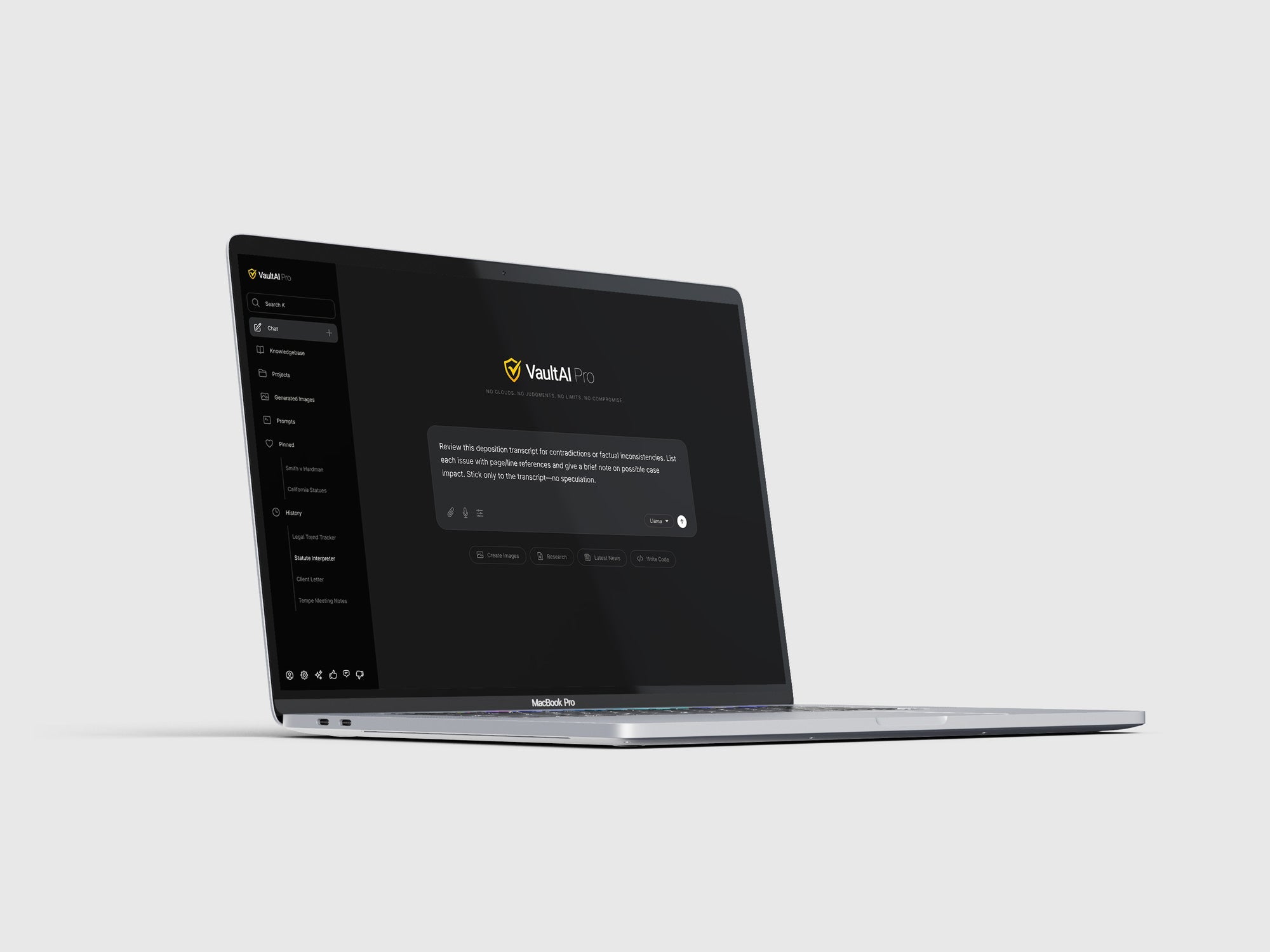
Every time you type a question into ChatGPT, Claude, or Gemini, that question leaves your computer, crosses the internet, hits a data center, gets processed, gets logged, and — in most cases — gets stored.
Your medical questions. Your business strategies. Your creative writing. Your code. Your insecurities. All of it, sitting on someone else's servers.
We've been conditioned to think this is normal. It's not.
The Privacy Problem Nobody Talks About
OpenAI's own privacy policy states that conversations may be reviewed by human trainers. Google's Gemini conversations are used to improve their products. Microsoft Copilot data flows through Azure. Anthropic stores your Claude conversations.
"But I have nothing to hide."
You do. Everyone does. Not because you're doing something wrong — but because your ideas, your work, and your personal thoughts have value. And right now, you're giving that value away for free.
What "Local" Actually Means
When we say VaultAI runs locally, we mean it literally:
- Requires zero network connections. Turn your wifi off and everything still works — every model, every answer, every image, produced on your own machine.
- Everything on your hardware. The AI models, the app, your conversations — all stored on the SSD you hold in your hand.
- Nothing you write is sent anywhere. Your prompts, documents, and generated content never leave the drive. There is no account, no sync, no telemetry.
- Unplug and it's gone. Remove the SSD from your computer and there is no trace of VaultAI or your conversations on the host machine.
This isn't a privacy setting you toggle on. It's the architecture.
But Is Local AI Any Good?
Two years ago, local AI was a toy. Small models, slow inference, poor quality.
That era is over.
VaultAI ships with models like:
- Qwen3-235B — a 235 billion parameter model that rivals GPT-4 on benchmarks
- GPT-OSS 120B — a 120-billion-parameter powerhouse built for the hardest reasoning and research
- DeepSeek-R1 32B — deep reasoning that matches or exceeds many cloud models
- GLM-4 32B — an open model that reasons and writes at the level of far larger ones
These aren't hobbyist experiments. These are state-of-the-art models from Google, Mistral, Alibaba, IBM, and the open-source community. The same architectures powering cloud services — running on your hardware.
The Cost Math
ChatGPT Plus costs $20/month. That's $240/year. For access to a single model family on someone else's servers.
VaultAI Core costs $399. Once. For 21 models. On hardware you own. With no monthly fees, no token limits, and no usage caps.
In 20 months, VaultAI has paid for itself. Everything after that is free.
And unlike a subscription, VaultAI doesn't disappear when you stop paying. It's yours.
Who This Is For
If you work with sensitive data — client files, medical records, financial documents, legal contracts — you shouldn't be sending that through cloud AI services. Full stop.
If you value ownership — your conversations, your creative work, your code should be yours. Not training data for the next model.
If you're tired of subscriptions — one purchase, unlimited use, forever.
If you want more than one model — VaultAI ships with 21–46 models. Switch between them instantly. Compare answers. Use the right tool for the job.
Try the Math Yourself
| Service | Year 1 | Year 2 | Year 3 | Models | Privacy |
| ChatGPT Plus | $240 | $480 | $720 | 1 | ❌ Cloud |
| Claude Pro | $240 | $480 | $720 | 1 | ❌ Cloud |
| VaultAI Core | $399 | $399 | $399 | 21 | ✅ Local |
| VaultAI Ultra | $599 | $599 | $599 | 46 | ✅ Local |
By year 3, you've spent $720 on ChatGPT for one cloud model. Or $399 on VaultAI Core for 21 local models.
The choice is obvious.
VaultAI is available now at vaultai.us. Core $399 / Pro $499 / Ultra $599.
Share:
What 'Uncensored AI' Actually Means (And Why It Matters)
ChatGPT vs VaultAI: The Complete Comparison